Coastal Reserve Studies in Florida: How the Salt Environment Affects Component Lives
The more a property is exposed to a salt environment, the faster its exposed metals, coatings, and equipment age. A coastal Reserve Study should account for that environment honestly.
Salt Air and Component Life: The Introduction
If your property sits on or near the Florida coast, the ocean is quietly impacting your budget in a major way. The coastal environment introduces extensive amounts of salt air, storm events, and UV exposure.
Salt air accelerates corrosion in metals, wears down coatings, and shortens the life of exterior equipment. The good news is that advanced wear is often predictable. Predictable repairs and replacements can be planned and funded for. What follows in this article is contextual information intended to help you understand the environment's effects on your property and how it should impact that property's Reserve Study.
What qualifies as a coastal property in Florida?
There is no single universal definition of a "coastal property", although Florida law offers a historic reference point. The state's milestone inspection statute originally required buildings within 3 miles of the coastline (a term the Florida Statutes define) to complete their first structural inspection at 25 years of age instead of 30. A 2023 revision removed the variation so the 30-year mandate was statewide for consistency (though local enforcement authorities may still require an earlier 25-year inspection where conditions such as proximity to salt water justify it), although the 3-mile marker remains the benchmark during "coastal" discussions.
From a reserve planning perspective, we treat that same distance as a practical starting point: a property within roughly 3 miles of open salt water generally warrants coastal treatment in its Reserve Study. That said, exposure is a spectrum rather than a simple switch. Salt concentration in the air is highest at the oceanfront and on barrier islands and tapers off as you move inland. An oceanfront tower, a property on the Intracoastal, and a community 2 miles inland may have identical assets that age at different rates.
What Salt Air Does to a Building
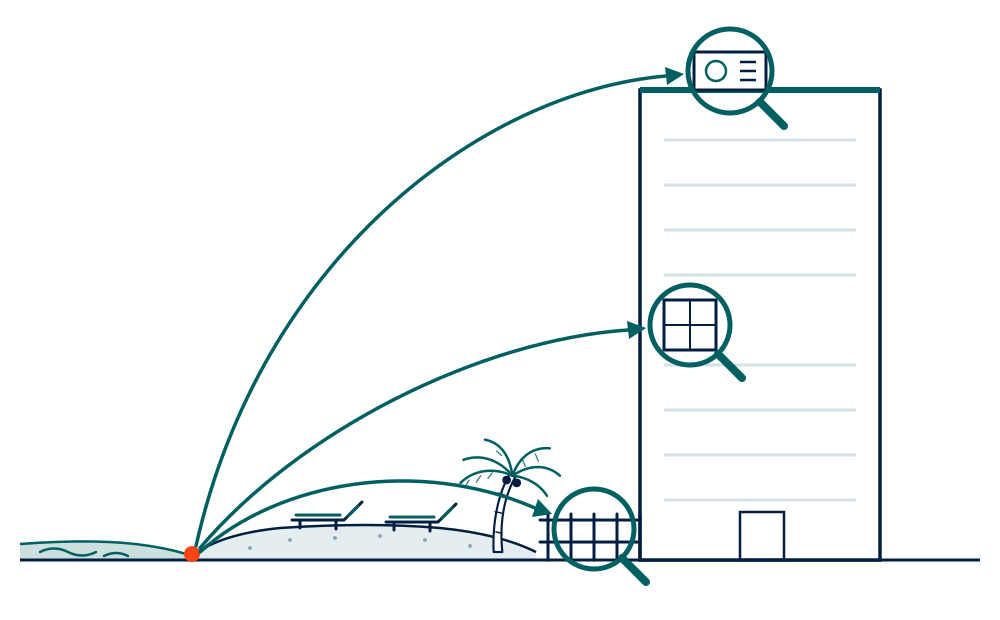
Salt travels inland as spray and airborne mist, and it settles on every exposed surface. It is corrosive to metal, hard on protective coatings, and persistent: it keeps working between storms, in fair weather, day after day. The components that feel its effects most fall into three main groups:
- Metals: Structural and reinforcing steel, balcony connections and hardware, fencing and railings, exterior doors, and exposed fasteners. Corrosion starts at the surface and, if left alone, exponentially advances inward until replacement is required.
- Coatings and Barriers: Paint, sealants, waterproofing, and roofing systems. These are the layers that keep water and salt away from everything beneath them, and coastal weather can consume their life faster than inland weather does.
- Exterior Equipment: Cooling towers, condensers for air conditioning systems, exhaust fans, pool heaters, and other exposed mechanical systems. Coils, cabinets, and electrical connections corrode ahead of their inland counterparts.
What a Coastal Reserve Study Should Include
Whether your association needs a SIRS or a traditional Reserve Study, a report for a coastal Florida property should give you all of the following:
- An on-site evaluation that examines the exposed components directly, considering their exposure to the surrounding environment.
- Useful Life (UL) estimates adjusted for salt exposure and storm stress, not broad assumptions. These should also take replacement history as available into account.
- Remaining Useful Life (RUL) estimates that reflect the property's actual maintenance history.
- Recommendations to proactively protect and prolong the Remaining Useful Life (RUL) of property components when possible.
- Replacement cost figures grounded in current local pricing rather than dated or generic numbers.
Frequently Asked Questions (Coastal Edition)
Will our components last as long as the manufacturer states they will?
Typically, no. Manufacturers' published life expectancies often aren't directly applicable unless the items were rated for coastal application to begin with. We recommend direct consultation with local industry professionals when conducting any major exterior project, as they will be able to recommend best practices for successful completion and longevity. They will also be able to provide a clearer expectation of life than manufacturers. Proactive maintenance following completion (or replacement) is equally as important to reaching a full life.
How often should a coastal Reserve Study be updated?
Conditions near the water change faster than most boards expect. Industry best practice is to conduct an update with a site visit once every three years. Depending on specific property design and complexity, annual updates could be beneficial between site visits. The state of Florida did set a requirement for SIRS to be completed once every 10 years, although traditional Reserve Studies have no such requirements.
Does a Reserve Study or Structural Integrity Reserve Study check whether a structure is actually safe?
No. Milestone inspections, which are performed by a licensed engineer or architect, exists for assessment of structural safety. That engagement determines structural conditions and lists requirements for structural repairs needed.
On the other side, both Reserve Studies and Structural Integrity Reserve Studies are financial planning tools only. They only include a visual assessment within their scope, of which visible concerns can (and should) be noted within the end report. However, those visual assessments would be followed with a recommendation for a more comprehensive evaluation of the concern by a licensed and/or qualified industry professional within a separate (potentially invasive) inspection.
This article is intended to be educational material for Florida board members and community managers, not legal advice. Consult legal counsel about your association's legal obligations regarding Structural Integrity Reserve Studies, reserve funding requirements, milestone inspection requirements, etc.
Turn the reading into your community's numbers
General answers only go so far. A scoped proposal applies them to the property your board actually manages.
Any statute references on this website were last reviewed on September 12th, 2026. Laws change, and no information on this website is intended as a legal opinion. Please verify current legislative requirements with your association attorney.